The global mHealth market was valued at $81.71 billion in 2025 and is projected to reach $104.47 billion by 2026 — with the broader mHealth services market expected to surpass $310 billion by 2034.
The rapid market growth alone no longer explains why healthcare organizations invest in mobile health.
In 2026, the biggest changes are regulatory and operational rather than technological. The FDA has updated its guidance on General Wellness and Clinical Decision Support software, Medicare has expanded reimbursement for prescribed digital mental health treatments, and providers increasingly rely on mobile applications as the patient-facing layer of connected care.

For healthcare organizations, product companies, and digital health startups, the question is no longer whether to build an mHealth application.
Digital transformation is the organization-wide frame, and we treat it separately in our guide to digitization and digitalization in healthcare. What follows is the mobile layer specifically — the part of that transformation that reaches the patient directly, and the only part where a health system’s software choices are visible to the person being treated.
Thus, the challenge is understanding:
- what type of product they are building
- which regulations apply
- what evidence supports clinical adoption
- how the application fits into broader care delivery.
This article examines how mHealth solutions are driving digital transformation through chronic disease management, patient engagement, and remote monitoring, while explaining the regulatory, interoperability, and privacy requirements that determine whether a mobile health product can be deployed, prescribed, and reimbursed.
What Is Digital Transformation in Healthcare
Digital transformation in healthcare is a mix of processes aimed at enabling healthcare services or procedures with the help of electronic devices (including wearables) and particular software.
For instance, the doctors are now able to stream their operations to teach their colleagues throughout the world, to say nothing about the da Vinci™ surgical systems that the surgeons use to make the operations less invasive. The data that doctors collect from the patient has become more accessible to the end-user and helps to prevent many diseases if interpreted correctly. Of course, none of that would be available without a computerized solution like AI-powered software.
Let’s view the most common novelties that digital transformation in healthcare industry brought us.
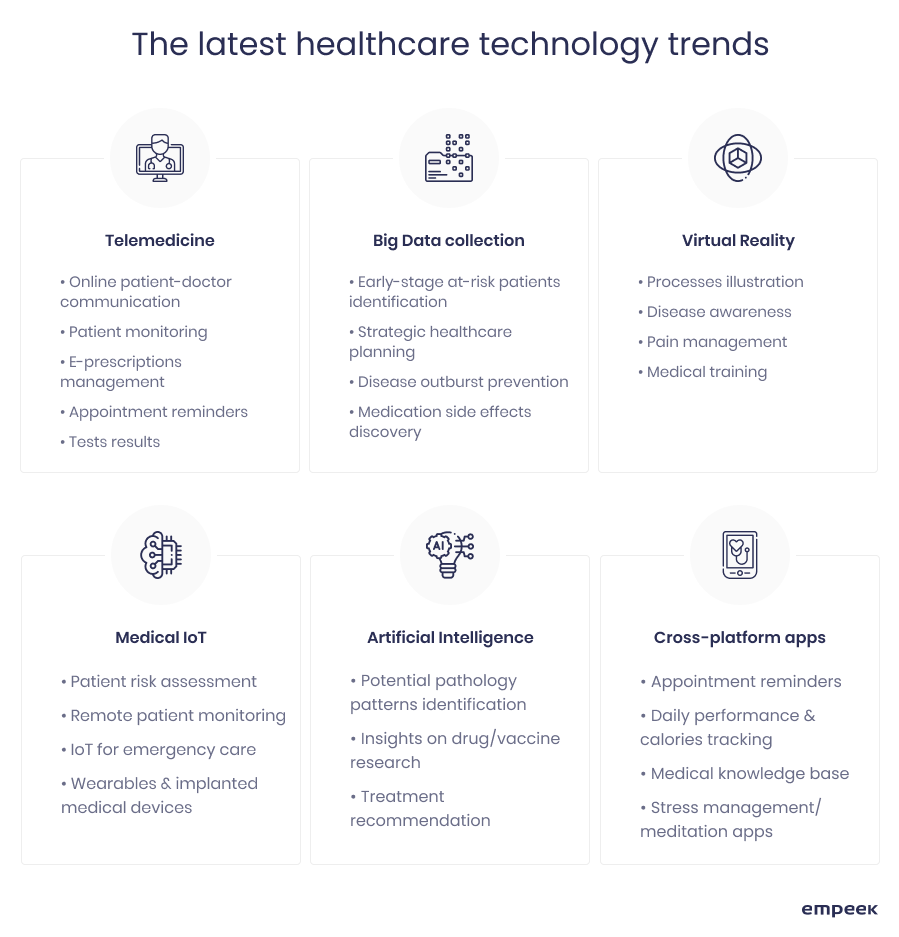
If used by every provider and patient, digital solutions have the potential to make healthcare simple, affordable, and more effective. However, making them mobile-first will cover the needs of more people since the demand for the mobile devices is growing exponentially. As a result, the healthcare provision will be easily accessible.
Let’s show how to automate paper processes in healthcare and why we think the healthcare digital transformation will only continue to revolutionize the whole medical system.
Impact and Role of Digital Transformation in Healthcare
The current Mobile Health (mHealth) market is expected to grow at a rate of 28.8% from USD 40.59 billion in 2019 to USD 310.37 billion in 2027. This will be a stunning 7x increase in just 8 years. Many initiatives from both government-controlled and private companies have the “digitization of healthcare” in their strategic planning, all with the sole aim: to make the service provision patient-centered.
This includes:
- Empowering patients with their health available at their fingertips
- Reducing medical expenses by introducing preventive and cost-effective treatment, visits, and care
- Increasing access to patient’s health information for doctors, hospitals, and clinics
- Promoting patient’s outcome improvement through fact-based decision-making
- Supplying data for predictive modeling of the at-risk population, and thus improving preventive care
Certain elements of e-prescribing software make the healthcare industry step forward. Provided universally, the patient-centered approach can revolutionize the way we get medical treatment and lead the way for effective healthcare available worldwide. What are the current healthcare technology trends and tendencies of the digital health market regarding the transformation? Let’s review them in detail.
mHealth vs. Telehealth vs. IoT: Understanding the Difference
These terms are often used interchangeably, but they represent different layers of digital healthcare.
mHealth refers to software delivered through smartphones, tablets, and wearable companion applications that enables patients and clinicians to capture health information, communicate, manage treatment plans, and support ongoing care.
Telehealth describes the remote delivery of healthcare services through video consultations, messaging, or telephone interactions. We discuss this area separately in our Telehealth Trends overview.
Healthcare IoT refers to connected medical devices and sensors—including blood pressure monitors, glucose meters, cardiac monitors, and wearables—that generate physiological data. We cover this technology stack in our IoT in Healthcare guide.
Modern healthcare solutions frequently combine all three technologies. A remote patient monitoring program, for example, may collect readings from connected devices, transmit them through secure mobile applications, and allow clinicians to conduct follow-up consultations remotely.
Below, we focus on the mHealth application layer—the software that transforms raw health data into workflows that patients and clinicians can actually use.
What counts as an mHealth solution in 2026
The most useful way to classify mHealth solutions is not by application type, but by regulatory status. Regulatory classification determines development timelines, validation requirements, clinical evidence, reimbursement opportunities, and overall development cost.
General Wellness Products
Many mobile applications fall into the FDA’s General Wellness category. These products are intended to support healthy lifestyles through features such as physical activity tracking, nutrition guidance, sleep improvement, or stress management while presenting low risk to users.
Following the FDA’s January 2026 revision of its General Wellness guidance, certain wearable sensor technologies may also qualify, provided they do not make medical or diagnostic claims.
Products in this category generally do not require premarket submission.
Non-Device Clinical Decision Support
Some clinician-facing software is excluded from the medical device definition under Section 520(o)(1)(E) of the Federal Food, Drug, and Cosmetic Act.
To qualify, the software must satisfy specific requirements, including allowing healthcare professionals to independently review the basis of any recommendation rather than relying on opaque algorithms.
The FDA’s 2026 Clinical Decision Support guidance also expanded enforcement discretion for software that generates a single clinically appropriate recommendation, provided it is not intended for time-critical decision-making and meets the remaining statutory criteria.
Importantly, this exemption applies only to software supporting healthcare professionals. Applications providing clinical recommendations directly to patients or caregivers remain regulated medical devices.
Regulated Medical Device Software
Once an application interprets physiological signals, performs diagnostic functions, supports treatment decisions, or claims to detect or manage disease, it generally becomes Software as a Medical Device (SaMD).
Depending on risk classification, market authorization may require:
- 510(k) clearance
- De Novo classification
- Premarket Approval (PMA)
The difference between a wellness tracker and a regulated medical device often comes down to intended use and marketing claims rather than software functionality alone. A wearable collecting heart rate data may remain a wellness product, while the same device claiming to detect arrhythmias becomes subject to medical device regulation.
For product teams, intended use should therefore be defined before software architecture or feature prioritization begins.
Reimbursed Digital Therapeutics
A growing category of mHealth solutions combines regulated software with established reimbursement pathways.
Digital mental health treatment devices now have dedicated Medicare reimbursement codes, while Remote Physiologic Monitoring (RPM) continues to expand through updated CMS payment models.
Unlike traditional wellness applications, these products require both regulatory authorization and sufficient clinical evidence to support reimbursement.
Two applications can appear nearly identical to users while requiring dramatically different investments in validation, clinical studies, quality management systems, and regulatory submissions.
Understanding where a product fits within these four categories is therefore one of the earliest—and most important—decisions in mHealth development.
Where mHealth Is Delivering Measurable Clinical Outcomes

Chronic disease management
Chronic disease management remains the strongest clinical application of mHealth technology. Diabetes, hypertension, cardiovascular disease, respiratory disorders, and obesity all require continuous self-management between physician visits, making mobile applications particularly valuable.
Evidence supporting these solutions continues to strengthen.
A 2025 systematic review and meta‑analysis of randomized controlled trials on m‑health app‑supported interventions for type 2 diabetes found that app‑based interventions significantly improved glycemic control and were associated with better self‑management behaviors.
A separate meta-analysis examining mobile applications for diabetes and hypertension reported measurable improvements in HbA1c as well as reductions in systolic and diastolic blood pressure.
More important than the average effect size, however, was identifying which application capabilities consistently contributed to better outcomes.
Production-grade chronic disease platforms typically combine:
- blood glucose or blood pressure monitoring
- medication reminders and adherence tracking
- automated feedback based on patient readings
- personalized health goals
- educational content
- longitudinal trend visualization
- secure communication with clinicians
- configurable clinical alerts.
These features appear consistently across studies demonstrating measurable improvements, suggesting that successful chronic disease platforms rely on coordinated workflows rather than isolated functionality.
For healthcare organizations, this shifts attention from launching applications toward maintaining long-term participation through clinically meaningful interactions.
Empeek applied these principles while developing a Remote Patient Monitoring platform that uses cellular and Wi-Fi connectivity to collect health data from home devices securely integrating:
- Blood pressure monitors
- Connected scales
- Glucose meters,
to support continuous home monitoring and clinician review.
The platform supports per-patient threshold customization and automated alerting, enabling chronic disease monitoring.
Related: Chronic disease management software
See the full case study
Patient Engagement and Continuous Care
While chronic disease management demonstrates the strongest clinical evidence, patient engagement has become the operational foundation of modern mHealth.
Healthcare organizations are moving away from episodic interactions—an annual appointment followed by a phone call or mailed instructions—toward continuous communication that helps patients stay connected to their care teams between visits.
Effective mHealth applications support engagement through practical workflows rather than standalone features. These commonly include:
- secure messaging between patients and care teams;
- personalized reminders for medications, appointments, or care plans;
- educational content tailored to specific conditions;
- symptom check-ins and progress tracking;
- goal setting with visual progress indicators;
- digital questionnaires and patient-reported outcomes.
The value of these capabilities lies in reducing friction. Patients no longer need to remember symptoms weeks later during an office visit, while clinicians receive structured information that supports earlier intervention.
Behavioral science also suggests that visible progress, personalized feedback, and timely communication contribute more to long-term engagement than one-time onboarding experiences. Consequently, successful mHealth products are designed around sustained interaction rather than initial downloads.
Empeek has implemented similar engagement principles in VelloHealth, a mobile and web platform supporting Assertive Community Treatment (ACT) teams.
Secure communication, mobile documentation, and coordinated workflows contributed to measurable improvements in completed patient visits while reducing administrative overhead.
Remote Monitoring: The mHealth Application Layer
Remote Patient Monitoring (RPM) is often discussed as an IoT capability, but its clinical success depends equally on the mobile application.
Connected medical devices generate physiological data, yet those readings become clinically valuable only after they are transformed into workflows that clinicians and patients can act upon. The mHealth application serves as that operational layer by:
- presenting measurements in understandable dashboards;
- notifying patients when readings require attention;
- routing clinically significant alerts to care teams;
- documenting observations for longitudinal review;
- supporting communication between patients and providers.
Without this application layer, connected devices simply produce isolated measurements. mHealth software converts those measurements into continuous care processes.
Modern RPM applications commonly integrate with:
- blood pressure monitors;
- connected weight scales;
- pulse oximeters;
- continuous glucose monitors;
- cardiac monitoring devices;
- wearable sensors.
Rather than alerting clinicians about every incoming reading, mature platforms prioritize clinically meaningful changes using configurable thresholds, helping reduce alert fatigue while supporting earlier intervention when necessary.
One of the strongest predictors of long-term program success is not the number of devices deployed but the percentage of enrolled patients who continue transmitting meaningful data over time. Monitoring patient retention and transmission rates therefore becomes as important as monitoring clinical metrics.
The Reimbursement Layer
Coverage is the clearest signal of what payers consider clinically real about mHealth solutions, and it moved twice in eighteen months.
Digital mental health treatment. Effective January 1, 2025, CMS established three HCPCS codes: G0552 for supply of a DMHT device plus initial education and onboarding, billed once per course of treatment; G0553 for the first 20 minutes of monthly treatment-management services; and G0554 for each additional 20 minutes.
Payment is conditioned on the device holding FDA 510(k) clearance or De Novo authorization and being classified under 21 CFR 882.5801 — computerized behavioral therapy devices for psychiatric disorders.
The patient must have a diagnosed mental health condition, though the billing practitioner need not be the clinician who made the diagnosis. The CY 2026 final rule extended eligibility to devices classified under 21 CFR 882.5803, digital therapy devices for ADHD.
The gap between that policy and revenue is worth stating plainly. CMS acknowledged that claims volume has remained low, and attributed it partly to the requirement that the billing practitioner incur the cost of furnishing the device.
G0552 also carries contractor pricing rather than a national rate, meaning each Medicare Administrative Contractor sets its own reimbursable amount. A digital therapeutics business plan that assumes Medicare revenue needs a MAC pricing strategy alongside its clearance strategy.
Related: custom digital therapeutics software and mental health app development.
Remote physiologic monitoring remains the larger and more established pathway, and the CY 2026 fee schedule added codes covering shorter data-collection windows and shorter management time — relevant to any program where patients transmit fewer than sixteen days of readings per month.
We cover the mechanics in remote patient monitoring development, and the device-side build in a wireless cardiac monitoring case study.
Why Long-Term Patient Engagement Determines mHealth Success
Most mHealth solutions do not fail at launch. It might happen at month four, when transmission rates fall, the alert queue empties, and the clinical signal thins out to the point where the care team stops trusting it.
This is the mechanism behind the thin long-term evidence noted above, and it is measurable well before it becomes a clinical problem: the metric to instrument on day one is the share of enrolled patients still transmitting on a given day, tracked by cohort, not cumulative downloads or monthly active users.
Three design responses hold up:
- Trigger alerts on clinically meaningful change rather than on streaks or completion rates
- Route alerts into the clinician’s existing worklist rather than a separate dashboard nobody opens
- Staff the review workflow before shipping, because an alert with no owner is a liability rather than a feature.
Empeek’s work on patient engagement software starts from the retention curve, not the onboarding funnel.
Adoption obstacles are covered separately in our piece on barriers to mHealth adoption.
HIPAA, GDPR, and What Actually Applies to an mHealth App

Regulatory compliance is often treated as a late-stage implementation task. In practice, it should shape product strategy from the outset.
The intended use of an mHealth application, the data it collects, and the organizations it serves determine which regulatory frameworks apply long before development begins.
HIPAA and Data Management
A common misconception is that any application collecting health information automatically falls under HIPAA. That is not the case.
In the United States, HIPAA applies through the relationship between organizations. It governs healthcare providers, health plans, healthcare clearinghouses, and their business associates—not every company that develops a health application.
A direct-to-consumer wellness application that operates independently of healthcare providers will generally fall outside HIPAA, even if users record health-related information. However, the same application may become subject to HIPAA requirements once it stores or processes Protected Health Information (PHI) on behalf of a covered entity.
For organizations building clinical mHealth platforms, HIPAA requirements typically include:
- encryption of PHI both in transit and at rest;
- role-based access controls following the principle of least privilege;
- comprehensive audit logging of PHI access and modification;
- secure authentication and session management;
- Business Associate Agreements (BAAs) with cloud providers and third-party vendors handling PHI.
Even when HIPAA does not apply, health applications are not necessarily unregulated.
Following amendments that took effect in 2024, the FTC Health Breach Notification Rule explicitly applies to many consumer health applications outside HIPAA. The revised rule broadened the definition of a reportable breach to include unauthorized disclosure of health information—not only security intrusions.
This means inappropriate sharing of health data with advertising or analytics platforms may trigger regulatory obligations even when no external attack has occurred.
For development teams, this reinforces an important architectural principle: privacy requirements should be evaluated alongside system design rather than addressed after launch.
GDPR and the European Regulatory Landscape
Organizations developing mHealth solutions for European users face a separate set of obligations.
Under Article 9 of the General Data Protection Regulation (GDPR), health information is classified as a special category of personal data requiring additional legal protections. In many consumer-facing applications, processing this information relies on explicit, freely given, and clearly documented consent.
Compliance extends beyond obtaining consent. Development teams must also consider:
- data minimization principles;
- purpose limitation;
- users’ rights to access, correct, and delete their information;
- data portability;
- appropriate retention policies.
Medical device qualification in Europe is governed separately under the Medical Device Regulation (MDR).
In 2025, updated MDCG guidance further clarified software qualification and classification while incorporating references to the European Health Data Space (EHDS).
The EHDS Regulation entered into force in March 2025 and introduces additional interoperability, labeling, and transparency requirements for certain wellness applications claiming compatibility with Electronic Health Record systems.
While many implementation requirements will phase in over several years, organizations building new digital health products should consider these obligations early to avoid costly redesigns.
For companies targeting both US and European markets, regulatory planning is not simply a compliance exercise—it influences architecture, consent management, audit logging, interoperability, and deployment strategy.
Security Considerations for Modern mHealth Applications
Healthcare applications process some of the most sensitive personal information while operating on consumer mobile devices. Security therefore becomes a core product requirement rather than a technical enhancement.
Production-grade mHealth platforms commonly implement several foundational controls.
Protect Sensitive Data on Mobile Devices
Health information stored temporarily on smartphones or tablets should remain encrypted using platform-native security capabilities such as secure key storage and encrypted local databases.
Applications should also minimize local data retention whenever possible.
Keep Protected Health Information Out of Push Notifications
Push notification services provided by Apple and Google are not designed to carry Protected Health Information.
Instead of displaying clinical information directly, notifications should encourage users to securely open the application where authenticated access controls protect sensitive data.
Implement Modern Authentication
Healthcare applications increasingly rely on OAuth 2.0-based authentication combined with short-lived access tokens, refresh-token rotation, and biometric authentication where appropriate.
Multi-factor authentication is often expected for clinician-facing systems handling sensitive clinical workflows.
Maintain Complete Audit Trails
Organizations operating regulated healthcare software must be able to demonstrate who accessed patient information, what actions were performed, and when those actions occurred.
Comprehensive audit logging supports compliance investigations, security monitoring, and clinical accountability.
Secure Third-Party Integrations
Analytics platforms, messaging services, cloud infrastructure providers, and external APIs should all undergo security and compliance review before integration.
Introducing an unvetted SDK into a healthcare application may expose patient information even when the application’s own code meets regulatory requirements.
Security therefore extends beyond application code to the entire software supply chain.
EHR Integration: Connecting mHealth with Clinical Workflows
Many modern mHealth applications exchange information with Electronic Health Record (EHR) systems, allowing patient-generated health data to become part of routine clinical care.
The interoperability standard increasingly used for these integrations is FHIR (Fast Healthcare Interoperability Resources), typically combined with SMART on FHIR authorization for secure access.
In practice, a typical workflow involves:
- The patient records health information through the mobile application or connected medical device.
- The application structures this information using standardized FHIR resources such as Observation.
- SMART on FHIR securely authorizes communication with the healthcare organization’s EHR.
- Clinicians review validated patient-generated information directly within their existing workflow.
Although reading information from EHR systems has become increasingly standardized, writing patient-generated data back into clinical records remains significantly more challenging.
Healthcare organizations must determine:
- which observations should become part of the permanent medical record;
- how incoming information should be validated;
- which clinicians are responsible for reviewing alerts;
- how abnormal findings are incorporated into existing care pathways.
Consequently, successful interoperability projects involve workflow redesign as much as API integration.
Empeek has implemented integrations with leading healthcare platforms as part of remote patient monitoring, behavioral health, and connected medical device solutions, enabling clinicians to access patient-generated information without leaving familiar clinical systems.
Related: EHR/EMR Development Services
The Benefits of Digital Transformation in Healthcare for Patients and Providers
Although they belong to different camps, both providers and patients have an interest in healthcare processes that are easy, accessible, cost-effective, and efficient. So, how does every digital solution we talked about earlier benefit the providers and patients?
What is digital transformation in healthcare: provider’s perspective
More accessible telemedicine
The rapid pharmacy preceptor development is step zero for providing every person with effective initial healthcare. With the proper network and mobile device, doctors can provide initial consultations at a low cost, helping out the low-income patients or those living far from the hospitals. In this way, it will be possible for providers to cover the needs of patients beyond the metropolitan areas.
More accurate EHRs available in mobile devices
With a variety of mobile devices, speech-to-text programs, and many other technologies, the providers are empowered with the precision of adding the medical entries by voice. This shortens the appointment time and still makes every note being added. This is crucial for keeping the information about one’s health as complete and correct as possible. Besides, the rising promise of making it available cross-network will give the new providers the benefit of having a full clinical picture of the patients even if they just became the clients.
More effective management
Every provider wants to manage the services, staff, and patient flow cost-effectively. Collecting the data from the patients and the doctors will help the management to tailor their services to the client’s needs. Additionally, it will give a real-time insight into the market and allow for shaping a long-term digital strategy.
Online diagnosis of at-risk patients
Online diagnosis of at-risk patients especially concerns the patients with implantable devices like cardiac pacemakers, implantable cardiac defibrillators (ICDs), coronary stents, hip implants, interocular lenses, and implantable insulin pumps. Their diagnostic and receiving the maintenance alerts can be done without the patient visiting the doctor’s office, which will cut spendings on the maintenance of the public areas at the hospitals and free the cabinets for those who require in-patient care.
More focus on patients
Because the software and AI will assist in filling in the health records, doctors will be able spend more time inquiring patients about their health and habits. This communication can lead to a better understanding of the clinical picture, improving the care quality, and establishing trustful doctor-patient relationships. As a result, the patient’s satisfaction rate will increase greatly.
More research
The data has no value without a thorough analysis and interpretation. By receiving the health alerts, analyzing patterns, identifying the common conditions and events frequency, the doctors have invaluable material for discoveries and innovation. For instance, the collected information about the prescribed drugs can reveal the common side effects, identify if it’s a habit-forming one, and find the substitute if needed. Get more insights on our recently developed project drug testing software system.
Research, accessibility, efficacy, and automation – these are the core benefits of digital transformation in healthcare for medical workers. Let’s see what’s good for the patients.
Benefits of Healthcare Digitalization for Patients
On-demand healthcare
It includes accessible and affordable telemedicine, searching of the insurance-accepted providers, making last-minute appointments, and much more. The ability to have it as easy as grocery delivery is nothing else but making healthcare fit a patient’s schedule and budget.
Active involvement in the process
Because smartphones are always with them, the patients are more likely to control their lifestyle and correct it if there is a medical need for that. For instance, one can control the consumption of fats and carbs by changing the diet, and the app gamification will make the transition period easier.
More peace of mind
One of the biggest concerns for those having an implantable device is that it might stop working one day, which may end up badly for the patient. Being able to diagnose patient condition regularly thanks to implanted devices decreases the chance of unpredictable circumstances occurring and allows people to live a healthy, active, and less stressful life.
More control of data usage
Privacy is precious, and one has a full right to know how the information is being used and control the access to the sensitive data. We predict that if the blockchain technologies will be used widely, the patients’ information will be breach-proof, which will enhance one’s ID security.
Final Thoughts
Digitalization has an immense impact on the healthcare systems throughout the world, and emerging technologies only move this process forward. Because of the implementation of digital platform solutions like EHRs, AI-powered programs, mHealth and telehealth devices, and medical wearables, the medical care quality and accessibility is becoming better, more affordable, and on-demand. Visit the additional article on the barriers to mhealth adoption.
At Empeek, we are dedicated to making the digitalization of healthcare a worldwide practice by developing custom medical software to empower the providers and patients with real-time knowledge. Contact us today and we’ll discuss how you can improve the healthcare delivery with us!

 Loading...