AI and Machine Learning Development Services for Healthcare

Our healthcare AI solutions—from clinical data pipelines and predictive models to enterprise AI strategy—are designed around FDA AI/ML guidance, HIPAA-compliant data architecture, and the clinical workflows where the output actually gets used. These AI/ML development services span the full lifecycle: data readiness, prototyping, deployment, and ongoing governance.

Request a Free Consultation


Security Always Comes First

Say goodbye to data security concerns by working with a software-compliant partner. Whether it is a clinical trial system, medical billing platform, or care management solution, an advanced custom healthcare software firm Empeek is always focused on the product’s security.

iso new size (1)
iso 2-1-1 new size
hl7-111 new size
hitech11-1 new size
hipaa-111 new size
gdpr-111 new size
fda-1-11 new size
dicom11-1 new size

Why Healthcare Teams Choose Empeek for AI & Data Development Services

Healthcare Expertise Across 70+ Projects

With 70+ healthcare projects including AI/ML services over 10+ years, Empeek’s models are trained natively on clinical data—FHIR, EHR-integrated datasets, and device streams—not adapted from general domains. Our engineering focus in developing AI solutions for healthcare is on production reliability: handling real-world data heterogeneity, workflow integration, and compliance (HIPAA, FDA software precertification guardrails) across deployment.

Compliance-First AI/ML Services Development

Every AI/ML services engagement at Empeek starts with regulatory context, not as an afterthought. We design FDA AI/ML Action Plan for embedded device software, including predetermined change control protocols for models that continue learning after release. HIPAA and GDPR compliance is built into the scope of our AI and ML development services from the start—de-identification, audit logging, and access controls are native, not retrofitted in data architecture. For AI in regulated medical device software, we apply ISO 13485-aligned processes where applicable. This compliance-first approach reduces remediation effort and accelerates deployment.

Clinical and Operational Data Fluency

Healthcare data arrives in varied formats—FHIR R4, HL7v2, C-CDA, USCDI, and device streams. We build AI-ready pipelines that normalize, validate, and transform these sources into model-consumable features. Outputs are delivered back into clinical workflows via FHIR CDS Hooks and EHR integration, not standalone dashboards.

AI/Data Readiness Assessment Process

Data Audit

Map and assess EHRs, device feeds, claims, and unstructured notes for completeness, quality, accessibility, and feature-engineering viability.

AI Use-case Prioritization

Score candidates on data feasibility, clinical impact, integration complexity, and regulatory class. Produce a ranked roadmap; drop non-viable cases.

Compliance Gap Analysis

FDA SaMD classification check (diagnostic/CDS claims) and HIPAA review for PHI in training pipelines. Deliver a bounded regulatory scope per use case. 

Build-vs-buy Guidance

Recommend custom build, third-party integration, or hybrid based on data quality, specificity, and strategic value. Flag cases where an existing validated solution is sufficient.

Feature image
Get an AI/Data Readiness Assessment

AI-Ready Architecture & Data Pipelines

Clinical Data Pipeline Design

Get AI and machine learning services enabling businesses to ingest, normalize, and structure EHR, claims, and device data into AI-ready formats. FHIR R4 mapping, HL7v2 parsing, C-CDA extraction, USCDI handling, and continuous biometric stream processing with sampling, timestamp alignment, and gap-filling. Built for reproducibility across training, validation, and production.

AI-Ready Infrastructure in AI and Machine Learning Services

MLOps tooling for experiment tracking, versioning, orchestration, and automated deployment across AWS SageMaker, Azure ML, or GCP Vertex — selected based on your cloud strategy, data residency, and cost constraints.

EHR-Integrated AI Architecture

Deliver predictions, risk scores, and CDS recommendations directly within clinical workflows via FHIR CDS Hooks and SMART on FHIR. No context switching — insights appear in the patient chart at the point of care. Underpinning this is a unified orchestration layer that manages AI/ML services—from real-time inference endpoints to batch model updates—ensuring that every predictive output is versioned, reproducible, and traceable to the exact model and training run that generated it.

Compliance-Aware Data Architecture

PHI de-identification before training, audit logging for every data access and inference event, and model-drift monitoring tied to regulatory alerts — not just engineering, but compliance review triggers when performance degrades. Designed for ongoing, not launch-day, compliance.

Healthcare AI Use Cases

Where AI adds value in healthcare is specific, not generic. Below are AI and Ml development services we provide most often — each grounded in a real data source, a defined model approach, and the compliance considerations that apply.

Medical Imaging Analysis

Computer-vision models read radiology and pathology images — typically DICOM studies and annotated pathology slides — to flag findings and prioritize studies for review. 

Because any diagnostic output can place software under FDA SaMD classification, we scope the regulatory pathway up front and validate models against labeled clinical datasets before deployment. 

The result is imaging support that speeds triage without overstating what a model is cleared to do.

Clinical Documentation & Ambient AI

NLP and speech models turn clinical notes and ambient consultation audio into structured documentation and medical codes — automating ICD/CPT coding and reducing charting burden. 

Input is free-text notes, dictation, and ambient voice; the pipeline is built HIPAA-safe, with PHI de-identified or access-controlled and every data event logged. 

The outcome is reduced time spent on documenting and consistent coding, with clinicians reviewing rather than transcribing.

Predictive Risk & Early Warning

Risk models score readmission likelihood, clinical deterioration, and sepsis risk using FHIR Observation and Condition resources as input features, with predetermined change control governing any model that continues to learn after release. 

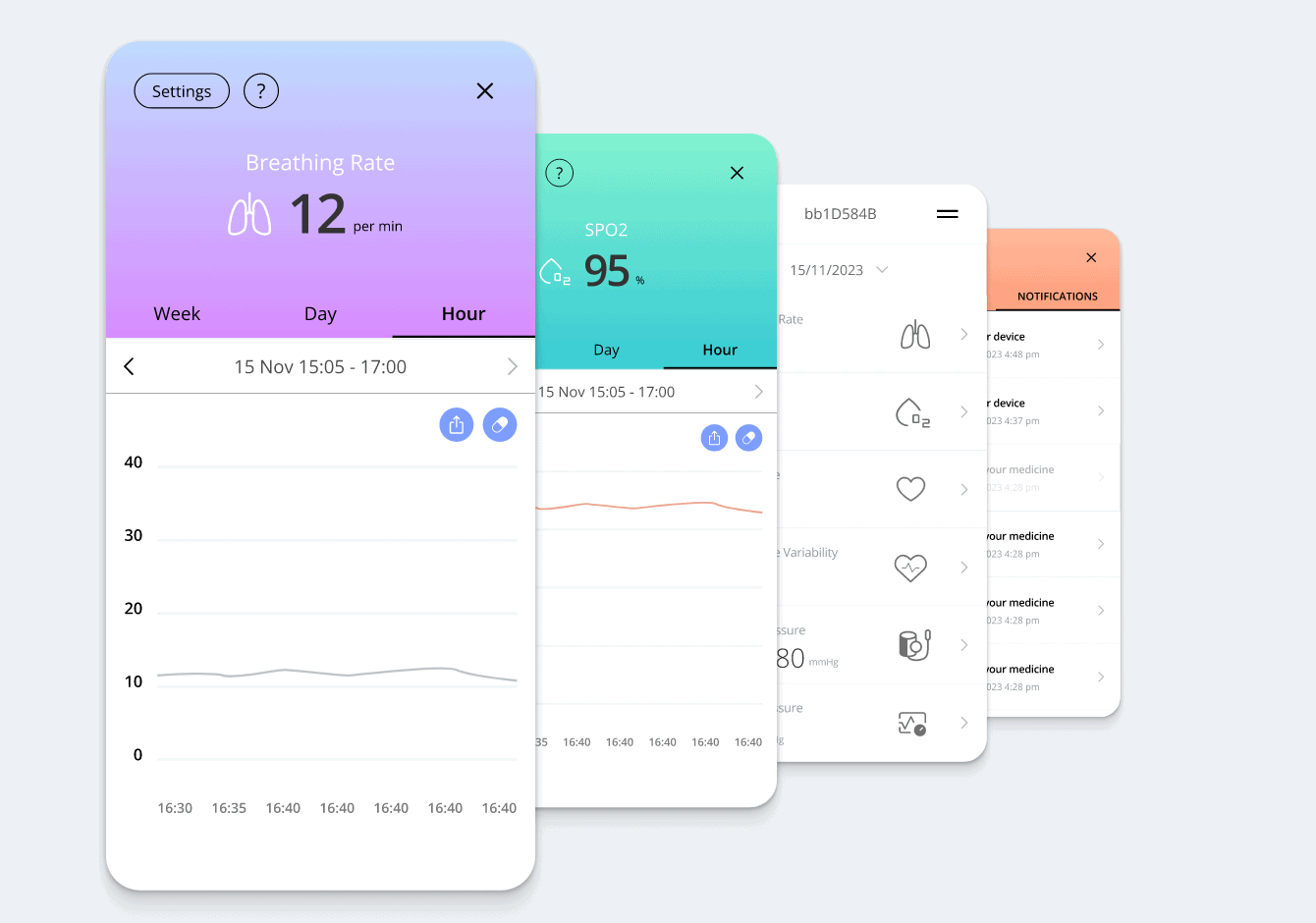
Empeek built this pattern for a digital-health RPM company as a multi-signal correlation engine — detecting deterioration as a compound pattern across weight, SpO₂, respiratory rate, and activity rather than single-threshold alerts. 

Verified results: time to identify and queue high-priority patients fell from roughly 15–20 minutes to under 2 minutes, and false-alert frequency dropped from about 65% to 12%.

Remote Monitoring Analytics

An AI layer in AI-driven analytics for RPM platforms on top of continuous biometric streams detects anomalies in RPM device data, separating real events from noise so clinicians aren’t buried in false alerts. 

Empeek delivered a neural-network system that classifies common and escalated cardiac events from historical heart-rate data and routes low-confidence events to a clinician, keeping human oversight in the loop. 

It also developed an AI-driven analytics platform on continuous PPG streams that is HIPAA- and GDPR-compliant, CE-marked and FDA-cleared.

Drug Discovery & Research Analytics

Machine-learning models support computational screening, biomarker identification, and trial-cohort matching — narrowing large compound libraries and patient populations to the candidates worth human review. 

Inputs range from molecular and assay data to de-identified clinical and genomic datasets, handled under research data-governance controls. 

The value is acceleration: fewer manual passes over large search spaces, without replacing scientific judgment.

Fraud Prevention & Revenue Integrity

Anomaly-detection models surface irregular claims and prior-authorization patterns for payer and revenue-cycle teams, working from claims data, prior-auth records, and billing histories. 

Because these outputs feed financial and compliance decisions, the models are designed to preserve a reviewable audit trail. 

The result is earlier detection of billing anomalies and protected revenue integrity, with humans adjudicating flagged cases.

Precision Medicine & Medication Adherence

Models combine genomics, EHR data, and behavioral signals to support treatment recommendations and to predict which patients are likely to fall off therapy — so outreach reaches them before a gap becomes a readmission. 

Genomic and behavioral data are among the most sensitive PHI categories, so handling follows strict HIPAA-aligned de-identification and access control. 

The outcome is targeted, earlier intervention rather than uniform follow-up.

Feature image

Core AI/ML Capabilities in Healthcare

Natural Language Processing

Clinical text processing: progress notes, discharge summaries, pathology reports, prior-auth docs. Applications: ICD/CPT coding suggestions, structured data extraction for quality reporting, prior-auth evidence extraction. Models trained on clinical corpora, validated against clinician-annotated ground truth. Architectures: transformers, NER, relation extraction tuned to clinical terminology.

Deep Learning in AI/ML Services

Modalities: medical imaging (radiology, pathology, dermatology), time-series physiological data (ECG, EEG, vitals), multi-modal inputs. Architecture selection: CNNs for imaging, recurrent/transformer models for time-series, fusion networks for combined data. Training protocols prevent patient-level data leakage across splits.

Predictive Analytics

Predictive models in AI and ML services address clinical and operational questions: readmission risk, length-of-stay, no-show probability, deterioration scoring, resource forecasting. Methods: gradient-boosted models, logistic regression, survival analysis—selected by interpretability needs and data characteristics. Calibrated probability outputs support clinical threshold setting. Model cards and performance docs included.

Robotic Process Automation

AI-augmented RPA for claims processing, prior authorization, scheduling, eligibility verification, referral management. AI handles payer format variation, non-standard layouts, and exceptions that break rule-based automation. Integrates with practice management and payer portals; audit logging included.

Feeling Confused About How Your Business Can Benefit From AI/ML Development?

Talk to an Expert

Enterprise AI & Data Strategy in AI and ML Services

Health systems, IDNs, and large payers face a distinct challenge: building a scalable AI portfolio, not accumulating disconnected pilot models.

AI governance frameworks

Define decision-making structures: who approves AI use cases, build-vs-buy criteria, prioritization against IT investments, clinical oversight. Roles defined for AI steering committees, clinical validation boards, and technical review processes.

Data governance and PHI lineage

Design frameworks that map data assets, access controls, and flow through AI pipelines. PHI lineage tracking enables tracing model predictions back to source data and governing access controls—essential for HIPAA compliance at scale and regulatory audit support.

Federated learning for multi-site systems

Train models across facilities without raw data leaving each site. Architect infrastructure that respects data sovereignty, handles heterogeneous site distributions, and maintains performance comparable to centralized training.

MLOps at scale

Standardized infrastructure for multiple models and teams: model registries, automated training pipelines, deployment orchestration, monitoring dashboards, incident response. Consistent governance and compliance controls across development, staging, and production.

AI portfolio prioritization

Evaluate AI candidates against clinical impact, data readiness, regulatory complexity, integration effort, and strategic alignment. Output: phased roadmap sequencing investments for maximum cumulative impact while managing technical and organizational risk.

Explore Enterprise AI & Data Strategy

Examples of AI and ML Development Services Client Cases

AI-Powered Heart Monitoring System

Clinical problem: Before automation, every cardiac-event decision was reviewed manually — slow, prone to human error, and impossible to scale, because throughput was capped by available staff. 

Model approach: A deep-learning neural network that automatically classifies defined common and escalated cardiac events (AFIB, pauses, V-TACH, bradycardia, and VE/SVE arrhythmia types), routing events below a 50% confidence threshold to a clinician for review.

Results: A first-to-market AI solution for real-time heart monitoring in its niche, classifying defined cardiac events at 90%+ accuracy to reduce manual review load and human error while handling large event volumes — delivered over 6+ months with a 2–5 person team for a US client.

Explore the Project
AI/ML Technologies 1

Examples of AI and ML Development Services Client Cases

Real-Time Health Monitoring Platform (BioBeat)

Clinical problem: Conventional remote monitoring relied on infrequent check-ins, bulky equipment, and limited data capture — leaving clinicians with too little signal to intervene in time. 

Model approach: AI-driven analytics applied to the continuous biometric stream, processed in real time on a cloud server, with actionable alerts triggered when readings fall outside personalized thresholds.

Results: Continuous 24/7 remote monitoring with early detection of vital-sign changes; a system scalable to monitor effectively unlimited patients across hospital and home settings; and roughly 2x lower operational costs for providers — delivered over an 8-month engagement for a healthcare/medical-IoT client.

Explore the Project
AI/ML Technologies 2

Our Healthcare AI/ML Development Services

By offering healthcare AI/ML services, we help care organizations to work their way towards a better and healthier future.

Discovery & AI/Data Readiness

Every engagement with AI healthcare solutions starts with your data landscape, clinical context, and regulatory constraints. Our AI/Data Readiness Assessment determines whether, where, and how AI adds value — as a standalone engagement or the basis for a full build.

MVP & Proof-of-Concept Development

For validated use cases, we build focused PoCs that test one thing: whether the model reaches target performance on representative data, whether clinical-system integration is feasible, and whether the regulatory pathway is clear. Scope is set for evidence, not production.

End-to-End AI Product Development

From data pipeline through model training, validation, deployment, and post-launch monitoring — including EHR integration and compliance documentation. AI and machine learning development services are delivered by a dedicated team of data engineers, ML engineers, and healthcare domain experts.

Cloud Infrastructure for AI

MLOps pipelines, model-serving infrastructure, and HIPAA-aligned security on AWS SageMaker, Azure ML, or GCP Vertex AI — selected against your existing cloud strategy and data-residency requirements.

QA & AI Model Validation

Distinct from functional QA. We test accuracy, robustness under distribution shift, subgroup fairness, and failure modes — producing validation documentation suited to FDA submissions, clinical review, or internal governance.

What Our Client Say

They developed what they promised and they’re always on time. Empeek is flexible when we need new arrangements or need help with another project. They were able to come up with resources within a reasonable amount of time.  One thing that stands out about Empeek is they’re not arrogant. None of the people I’ve worked with are like that. Empeek’s team is always nice and friendly.

Gregor Jarisch, CTO, EdTechFoundry AS

Need to scale your AI engineering team? See our Team Augmentation services

Go to Services

FAQs

Which industry uses AI ML the most?

The technology industry extensively embraces AI/ML, which has widespread applications across various sectors including healthcare, finance, retail, manufacturing, transportation, and more. In the healthcare field, AI/ML plays a vital role in analyzing medical images, diagnosing diseases, discovering novel drugs, and advancing personalized medicine. Within the finance sector, AI/ML is utilized for fraud detection, risk assessment, algorithmic trading facilitation, customer service automation, and numerous other purposes.

How companies use AI and machine learning?

Companies employ AI and machine learning in diverse ways, utilizing them for a broad array of applications. Some typical applications of AI and machine learning include processing human languages, recognizing images and spoken words, forecasting trends or outcomes through analytical models, automating routine procedures, and examining data for insights. These technologies empower companies to automate tasks, extract valuable insights from data, enhance decision-making processes, improve customer experiences, and optimize business operations.

How can I use artificial intelligence in my app?

To incorporate artificial intelligence into your app, consider implementing features such as natural language processing, image recognition, personalized recommendations, predictive analytics, sentiment analysis, and smart automation. These AI capabilities can enhance user experience and automate tasks, making your app more intelligent and user-friendly.

What FDA or regulatory considerations apply to AI/ML in healthcare software?

 It depends on use. AI that delivers diagnostic output, clinical decision support influencing patient management, or treatment recommendations may qualify as Software as a Medical Device (SaMD); administrative and operational AI (scheduling, claims processing) typically does not. 

The FDA’s AI/ML Action Plan sets out predetermined change control — documented processes for updating or retraining a model post-deployment without losing its regulatory status. 

We assess classification during the AI/Data Readiness Assessment and design accordingly. For AI embedded in regulated device software, we apply FDA AI/ML Action Plan processes and, where relevant, ISO 13485-aligned quality management.

How do you handle PHI in AI training pipelines?

Through architectural controls, not policy alone. De-identification removes or generalizes PHI before data enters training — via HIPAA Safe Harbor or Expert Determination. 

Where identifiable data is required (e.g., cross-system record linkage), it stays in access-controlled environments with full audit logging. Inference pipelines receive only the minimum necessary elements and don’t store raw patient data. Every flow is documented for HIPAA audit readiness.

What FHIR or clinical data formats do you work with for AI?

The ones healthcare organizations actually run: FHIR R4 resources (Observation, Condition, Patient, Encounter, DiagnosticReport) as both model inputs and integration points; HL7v2 for legacy systems; C-CDA and USCDI for quality-measure and population-health use. 

For EHR-integrated AI via FHIR CDS Hooks, we deliver recommendations directly into the clinician’s workflow. Proprietary device outputs are normalized into structured time-series for model consumption.

Do you support ongoing model monitoring and retraining after launch?

Yes, and in healthcare it isn’t optional, since model failure can affect outcomes. We monitor accuracy, calibration, and subgroup performance against defined thresholds. 

When drift or a planned update triggers retraining, it follows predetermined change control: what changed, why, and how clinical validity was reverified — preserving both performance and regulatory status.

What's the difference between an AI/Data Readiness Assessment and a full AI build engagement?

The Assessment is a focused, low-commitment engagement delivering your data landscape, prioritized use cases, compliance gaps, and build-vs-buy recommendation — it does not produce a working model. 

A full build executes on those findings: data pipelines, model training and validation, production deployment, and workflow integration. 

Start with the Assessment if AI is clearly relevant but you haven’t defined what to build or confirmed your data can support it.

Contact Us

Image preloader

Meet Empeek!

Scheduling a call made easy! Pick suitable time and let's get started

Book a call

Reliable Software delivery partner is closer than you think

  • HIPAA & GDPR compliance
  • 4.9 Rating on clutch
  • A winning tech stack
  • In-house team of versatile experts
  • Proven expertise in healthtech development

Alternatively, contact us directly: