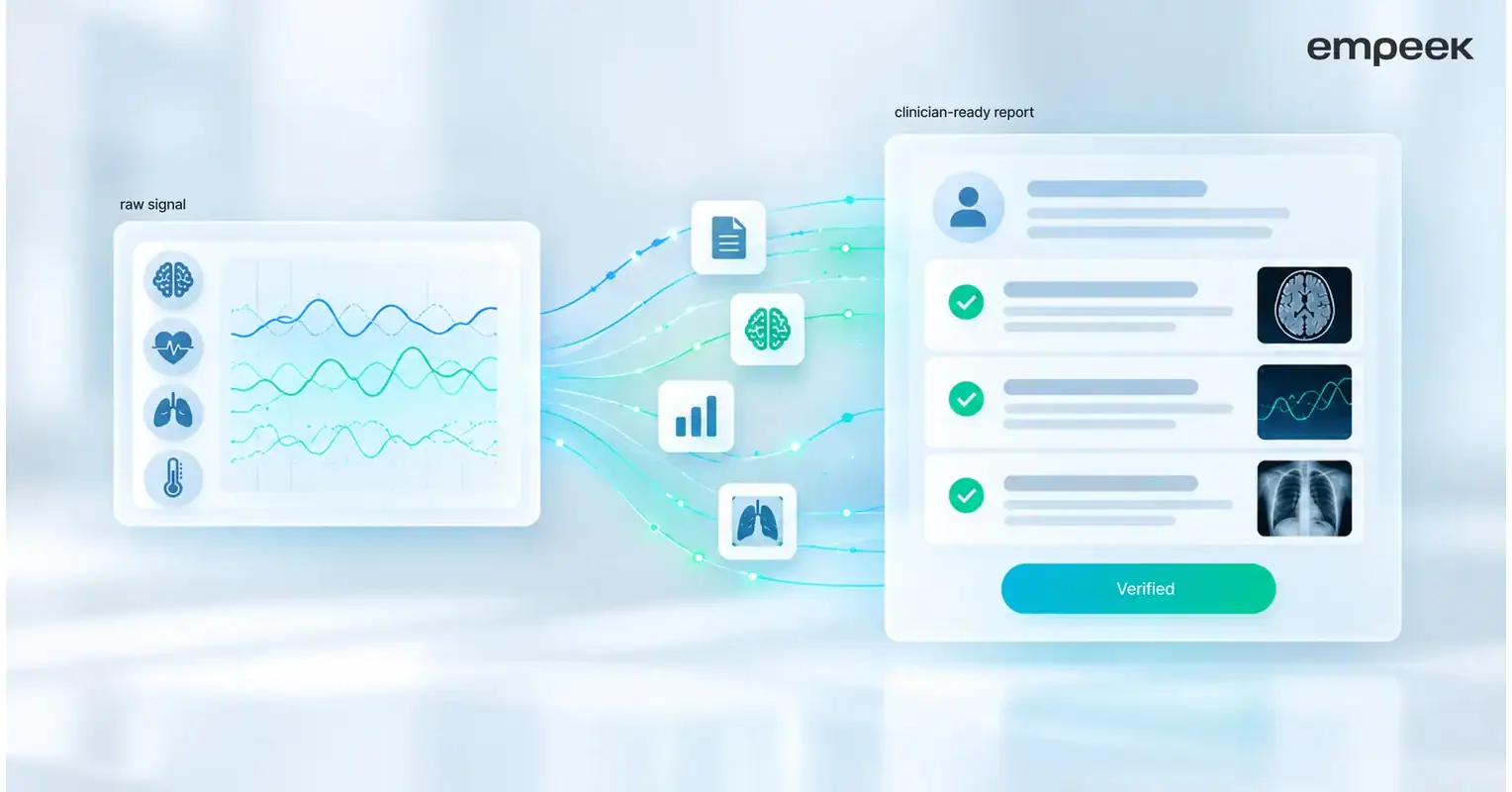
Measurement is no longer the full picture of the product.
Gait, EMG, force, motion, and/or balance data are becoming commonplace in rehab device software and biomechanics device software.
The differentiator has moved downstream into clinician-facing reporting: what can a clinician do with the output once a session is over?
This article outlines four stages of clinical readiness of a device’s output layer: interpretation, comparison, reporting, and workflow fit.
Why it matters
- Even though nearly 80% of U.S. physicians report seeing the advantages of using wearable and device information, less than 6% do so during clinical practice, showing that integration of these metrics into clinical practice is still limited.
- As for remote monitoring research, as much as 97% do not report basic aspects of the workflow such as provider response time, making real-world implementation and comparison almost impossible.
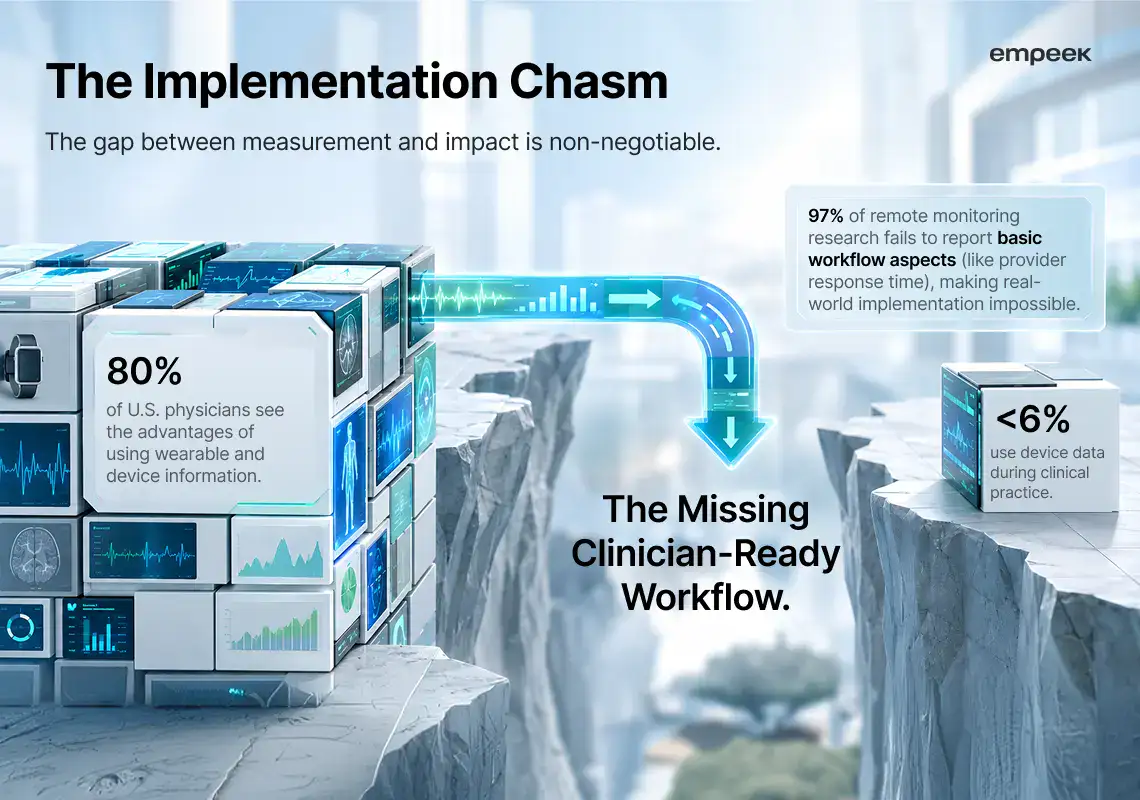
The gap between measurement and impact is the clinician-ready workflow and is not negotiable when it comes to medical devices.
It also explains where many OEM roadmaps under-invest.
The goal is to turn clinician-facing reporting into a workflow that helps a professional:
- Understand
- Contextualize
- Communicate
- Act on the result.
Why Capture Accuracy Stopped Being the Differentiator
A high-quality measurement foundation remains essential: if a device captures signals unreliably, no report can rescue it.
But accuracy is increasingly a baseline expectation rather than a complete value proposition.
The more consequential question is whether data becomes safe, intelligible, useful information for care delivery.
The FDA defines medical-device interoperability as the ability to “safely, securely, and effectively exchange and use information” among devices, products, technologies, or systems.
Exchange is only one part of the journey: data must also be displayed, stored, interpreted, analyzed, and, where appropriate, used by another system. A connected medical device software strategy that stops at capture or export leaves the highest-friction work to the clinic.
What varies enormously is the medical device data workflow that follows a session:
- whether raw values become a standardized assessment
- whether a clinician can see change over time
- whether the result can enter the patient record without rework.
When output is weak, sales conversations fall back to specifications and price—the comparison buyers can run most easily.
The answer is not to hide the data. It is to make the data legible, contextual, and operational—the foundation of a report a clinician can actually use.
The Four Levels of Clinician-Facing Reporting
The four levels below provide a practical way to evaluate an output layer before committing the next roadmap investment.

Interpretation: Turn raw metrics into clinical meaning
A chart is not an interpretation; it is a representation of measurements.
Clinician-facing reporting begins when the product helps users understand what a result may indicate within an assessment, while preserving the distinction between measured data and clinical judgment.
For a rehab or biomechanics product, this can mean organizing metrics around a standardized assessment, showing units and collection conditions, flagging missing or low-quality data, and using plain language to explain the relevant pattern.
The product should make the provenance visible: which patient, session, device, protocol, and processing method produced the result. It should not imply a diagnosis or treatment decision that the device has not been validated or cleared to make.
This is the first point at which medical device data workflow becomes a product-design problem rather than a sensor problem.
The useful question is not “How many metrics can we expose?” but “What clinical question does this view help answer?”
Comparison: Make progress visible without manual reconstruction
A single session can be informative, but many clinical decisions depend on change. Comparison should therefore include session-to-session views and historical analytics that clinicians do not have to build themselves.
A trend view can show how a selected measure changed, identify the assessment protocol used, and make deviations or missing sessions apparent.
Good comparison design is disciplined. It avoids implying that two values are directly comparable when the protocol, device configuration, side tested, or collection conditions differ. It also gives the user enough context to interpret a trend rather than presenting an attractive line with no explanation. This is where patient progress reporting becomes credible: the system shows the history and the conditions behind it, rather than manufacturing certainty from incomplete data.
A practical proof pattern is:
Device data → Standardized assessment → Historical analytics → Clinician-facing report.

Reporting: Produce a shareable clinical summary
Clinician-facing reporting should be a one-step output, not a final exam in data handling. It should preserve patient, session, and device context; identify the assessment or protocol; surface relevant findings; and make underlying measurements available for review.
It should support the intended audience, from treating clinician to referring professional or patient.
For teams evaluating clinical reporting software, the key distinction is between a document that exports data and one that communicates an assessment coherently.
A useful report can combine:
- A concise summary
- Visual evidence
- Prior-session comparison
- Space for clinician interpretation.
It should match local practice without sacrificing consistency or provenance.
The report is also a trust surface. Labels, units, timestamps, identifiers, and version information let a reviewer understand what was measured, when, and how it was generated.
Workflow Fit: Put the output where work already happens
Even a clinically meaningful report can fail if it lives in a bolt-on screen. The final level is workflow fit: the ability to use the output within the clinician’s existing documentation flow, with minimal duplicate entry and clear handoffs to the systems that hold the patient record.

Interoperability is not synonymous with workflow fit.
The FDA emphasizes safe and secure exchange, while health IT standards such as HL7 FHIR provide a consistent way for systems—including EHRs, laboratories, and apps—to share health information. Those capabilities are foundations, not guarantees.
Product teams still have to understand when the clinician needs the result, which fields belong in the record, how users review and amend it, and what happens when an integration fails.
That distinction is important because documentation burden includes more than typing.
A systematic review commissioned by the Agency for Healthcare Research and Quality identified time spent in the EHR, clinical review, workflow fragmentation, administrative tasks, and usability among the domains used to measure the burden.
A well-designed output layer should remove avoidable transitions rather than add a new destination.
What This Looks Like in Practice
Imagine a clinician using biomechanics device software during an assessment. The device captures movement and force signals under a defined protocol.
Afterward, the rehab device software associates the capture with the correct patient, session, device, and operator, applies the agreed assessment logic, and presents interpretable findings rather than an undifferentiated raw file.
The clinician can compare the current assessment with prior sessions and see which protocol and conditions produced each result. The platform then generates a clinician-facing report combining the summary, supporting visuals, trend information, and metadata needed for interpretation.
The report can be shared with the care team or transferred into the organization’s documentation process, subject to local configuration, privacy controls, and validation.
At follow-up, the clinician is not starting from a blank page or asking a patient to remember what changed.
The report prompts discussion of what was measured, what changed, what remains uncertain, and what should be documented next. That is what “good” looks like: not a prettier dashboard, but a complete path from raw capture to clinical communication.
Where to Start
Before adding another sensor, metric, or visualization, audit the product against the four levels. Can users interpret the result without expert mediation, compare sessions without reconstruction, produce a contextual summary, and use the output inside their existing documentation flow?
The questions we use are captured in a short self-check: the Clinician-Ready Device Data Checklist.
It is designed to help Product and Clinical Product leads identify the highest-friction gap, separate baseline interoperability work from genuinely useful workflow improvements, and prioritize the next investment with evidence from real users.
Use the checklist to assess your device’s output layer across interpretation, comparison, reporting, and workflow fit.
Share it with product, clinical, design, engineering, and implementation stakeholders to align on what clinician-ready should mean for your product.
Talk to a Team That Has Built This Layer Before
If the audit reveals gaps you are not sure how to close — or you would rather not rebuild the output layer by trial and error — talk to us.
At Empeek, we build medical devices and clinical software end to end: from signal capture and data architecture to clinician-facing reporting and EHR-ready workflows.
We have delivered wireless medical monitoring in real time for a continuous-care platform, and designed an intelligent chronic care hub that turns raw device and patient data into prioritized, actionable clinical views — the same downstream shift this article describes.
Bring us your device data and your clinical users; we will help you map the shortest path from raw capture to a report a clinician will actually use.
Get in touch to discuss your product.

 Loading...