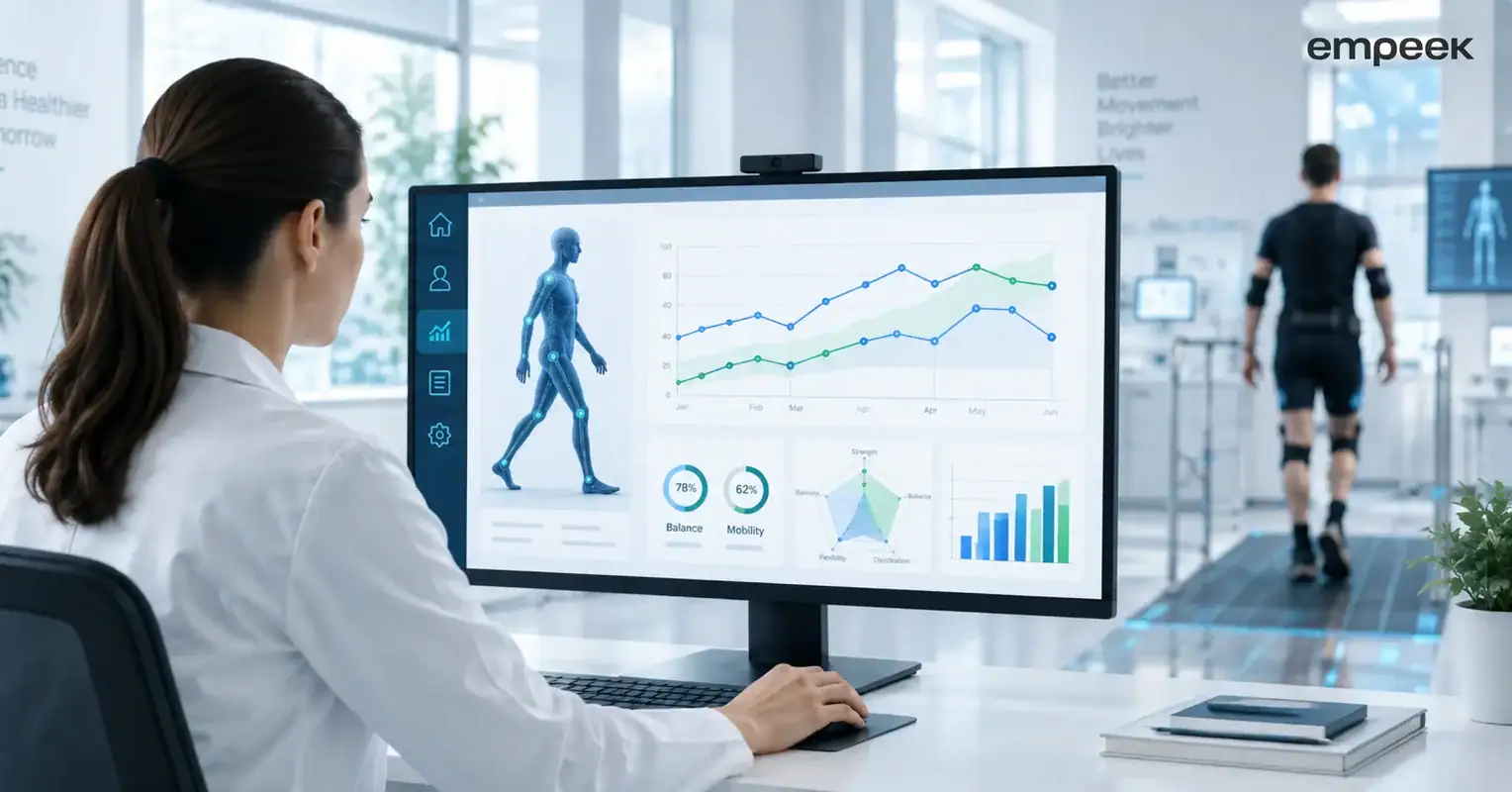
A device can capture an impressive amount of information and still leave a clinician without a useful answer. In a real appointment, the person using the system is rarely asking to see one more chart.
They need to know what matters, what changed, and how to communicate it without breaking eye contact or opening three other applications. Good medical device reporting turns measurements into a decision aid that supports the conversation already happening in the room. Here is what “clinician-ready” reporting requires beyond displaying numbers.
The Dashboard vs. the Appointment
A typical medical device dashboard is designed around capture and visibility. It may show raw metrics, trend lines, ranges, timestamps, and filters.
Those functions are useful, but a clinician in a five- to ten-minute session needs more: a concise answer, enough context to trust it, a shareable format, and a path into the note-taking process already in use.
That gap transfers work to the user.
Clinicians may still interpret raw metrics, compare sessions manually, or explain results outside the product. The clinician becomes the translator between a device’s data model and the patient’s care conversation.
Clinical technology is used inside a sociotechnical environment, not in isolation. AHRQ-funded research notes that electronic records can interfere with workflow, impede physician–patient communication, and increase cognitive load when systems do not reflect real work.
The same principle applies to device reporting: a technically correct screen can be unhelpful if the clinician must perform the final synthesis by hand.
What Clinician-Ready Medical Device Reporting Actually Requires
The standard for clinical reporting for connected devices should not be “more data.” It should be less avoidable work around data. Three qualities make the difference.
Context, not just numbers

A measurement without context is easy to misread and difficult to defend. A report should identify whose data are shown, when and how the session occurred, which device and software version produced the result, and what protocol was used. Depending on the product, it may also need the operator, body site, units, reference interval, quality indicator, and comparison baseline.
This is part of the evidence chain. The HL7 FHIR Provenance resource describes provenance as a record of the entities and processes involved in producing, delivering, or influencing a health-data resource. It helps a reader ask: “Where did this number come from, and can I rely on it?”
Context prevents a chart from appearing precise while hiding its assumptions. A clinician-ready output should distinguish an observed value from an interpretation, show the relevant time window, and make missing or low-quality data visible.
Shareable without translation

A report is not finished when the originating clinician understands it. A referring physician, care coordinator, payer, or patient should understand the essential message without a live tour of the interface.
A strong report separates the headline finding from supporting detail, uses plain language where appropriate, labels technical terms, and preserves the units, dates, and limitations that prevent overinterpretation. Different audience views should be presentations of the same trustworthy source, not narratives assembled manually.
The FDA’s guidance on medical device patient labeling emphasizes that information should be understandable and usable by patients and lay caregivers, supporting informed understanding of a device’s effects and expectations.
Although a clinician-facing report is not patient labeling, the design lesson is relevant: clarity is part of whether information can be used appropriately, not a cosmetic layer added after the technical work.
Fits the workflow, doesn’t fight it

Under time pressure, every extra handoff becomes a reason not to use a feature. Reporting that requires leaving the core product, downloading a file, renaming it, and duplicating the result into an EMR is reporting that will eventually be skipped or abbreviated. That is a workflow-design problem, not a motivation problem.
A credible EMR integration strategy should begin with the destination, not the export button. What information belongs in the clinical record? In what format? With what patient identity, timestamp, source, and provenance?
Which parts should be discrete data, which should be a human-readable document, and which should remain in the device application? ONC initiatives support secure, seamless sharing of electronic health information among authorized users and aim to improve care coordination.
Integration also means matching the patient reliably, preserving the session date, avoiding duplicate entry, supporting the clinician’s review sequence, and making corrections traceable. A patient data reporting software product may be technically interoperable and still create friction if users must reconcile mismatched identifiers or reconstruct the narrative in the EMR.
The FDA’s human-factors guidance centers intended users, uses, and environments to minimize use errors and resulting harm. For reporting teams, that means observing how clinicians prepare, review, explain, and document results—not simply asking whether a feature can be found.
The Cost of Getting This Wrong
The immediate cost of weak reporting is usually paid in minutes: someone compares sessions manually, writes a plain-language explanation elsewhere, or answers the support question the product should have anticipated: “How do I explain this to the patient?”
Repeated across users and appointments, that becomes part of the product’s operating model.
The burden can slow adoption. A clinician who must reconstruct meaning on every use may conclude that the device is valuable only in ideal conditions or with unusually motivated staff. Support demand rises as users ask how to turn the output into something clinically communicable.
There is a commercial consequence as well. Without an effective medical device reporting strategy, manufacturers lose their premium software differentiation: when reporting does not differentiate the experience, competitive evaluations slide back toward hardware specifications, acquisition price, and service terms.
Those factors matter, but they do not capture the value of reducing cognitive and documentation work. Clinician-ready output is a product capability, not merely a formatting preference.
This is not an argument for alarmist automation claims or reports that make clinical decisions on a user’s behalf. It is an argument for respecting the clinician’s time and judgment: make evidence easier to inspect, explain, document, and share while keeping its limitations visible.
A Practical Way to Check Your Own Reporting Layer
Before adding another visualization, run a self-audit using one representative end-to-end session and ask:

Then observe the failure points: how many clicks occur after measurement ends, where the clinician leaves the product, what gets copied by hand, and which question support hears repeatedly. These observations reveal whether the reporting layer is reducing work or relocating it.
A checklist makes this review consistent across devices, roles, and care settings. The objective is not the longest report, but the smallest trustworthy report that helps the right people understand, discuss, and document the result.

Put Your Reporting Layer to the Test
Use the Clinician-Ready Device Data Checklist to assess whether your reports provide the context, clarity, sharing, and workflow fit that real appointments demand.
It helps product, clinical, and customer-success teams identify friction before it becomes an adoption or support problem.
Ready to Close the Gap Between Data and Documentation?
If your self-audit surfaced gaps in context, communication, documentation, or workflow fit, that is exactly the layer we build.
Empeek’s medical device software development services cover the full path from sensor to EHR — sensor data pipelines, real-time clinical dashboards, and FHIR-based EMR connectors, built around IEC 62304 and FDA-aligned processes.
We have shipped this kind of reporting layer for real devices: a wireless medical monitoring platform processing continuous vitals in real time, an end-to-end remote cardiac monitoring system streaming ECG data from a wireless heart-monitoring device, and an IoT-based vital signs monitoring system built for continuous patient tracking.
Talk to our team about turning your device’s raw output into a report clinicians will actually trust and use.

 Loading...