Client Profile
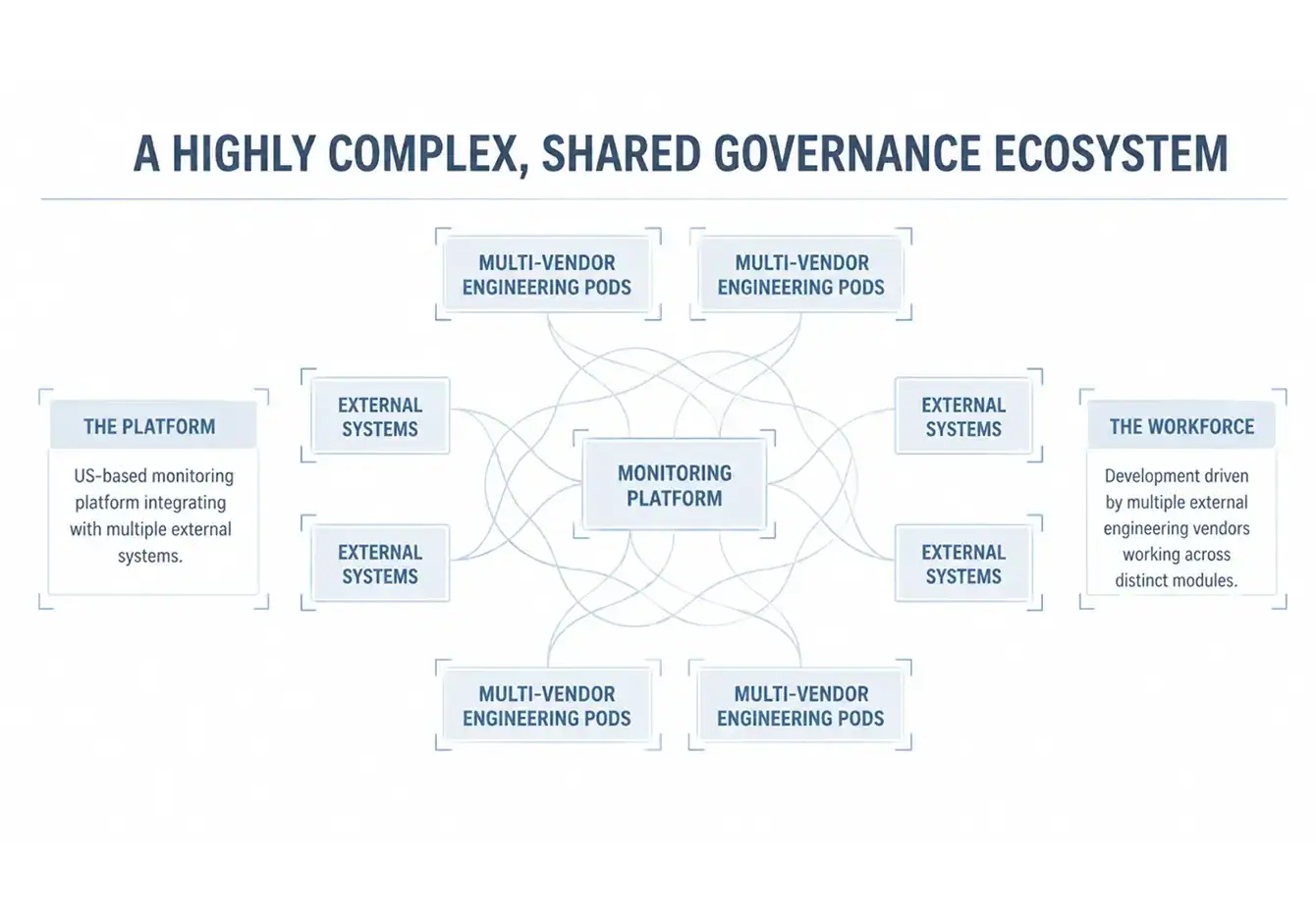
This case study is confidential and shared under NDA. The client is a US-based software company operating a monitoring platform that integrates with various external systems and supports a growing customer base.
Product development involved multiple independent engineering vendors working across different platform modules under a shared governance model.
As the platform evolved over several years, increasing complexity and fragmented delivery practices made it progressively harder to maintain predictable planning, consistent quality, and efficient collaboration.
Background
While already maintaining a delivery cadence of two releases per week, the client wanted to improve overall delivery performance without disrupting an experienced engineering team.
An operational assessment revealed that the core challenge was not engineering capability but the Software Development Lifecycle itself.
Specifically, planning was volatile due to mid-sprint scope changes, engineering teams operated in silos with limited alignment, and quality assurance remained heavily reliant on manual testing.
Rather than addressing isolated issues, the engagement focused on understanding how SDLC practices affected delivery outcomes and identifying opportunities to optimize the entire delivery process.
Challenges
The existing SDLC had gradually become difficult to sustain. Multiple vendors contributed to different parts of the platform, making coordination and ownership more complex.
Requirements were often incomplete or changed after development had started, reducing planning accuracy and increasing rework. Automated testing covered only 4% of the codebase, while manual testing covered only part of the required scope.
Operational analysis also showed that approximately one-third of engineering capacity was consumed by meetings, interruptions, coordination, and rework instead of focused product development, resulting in recurring production defects and unpredictable delivery.

The Solution
Empeek rebuilt the lifecycle as a Crisis Recovery Framework rather than isolated handoffs.
The framework alternates between evidence work and alignment work:
Objective Analysis
Objective analysis establishes the true state of delivery, and a direct conversation ensures stakeholders agree on that reality before any corrective action is planned.
Stabilization Plan
From there, a stabilization plan is built so that every action targets a specifically named weakness, and it is executed without pausing ongoing delivery.
Resilience Stage
The cycle closes with a resilience stage that documents warning signs and response steps, so if instability resurfaces, the same sequence can be re-triggered rather than requiring a new intervention from scratch.

Solution Sum-up
- Once baseline metrics established the root causes of delivery instability, Empeek redesigned key SDLC practices rather than adding isolated process improvements.
- Requirements were structured through a dedicated Business Analyst and a Definition of Ready, while a structured planning cadence replaced ad hoc scope alignment.
- Standardized quality gates introduced consistent smoke and regression validation before releases, and dedicated sprint capacity was reserved for architectural improvements.
Together, these changes created a more predictable, measurable SDLC without reducing delivery speed.

Business Outcomes
Planning accuracy, production defects, deployment frequency, and team NPS were measured before and after the SDLC optimization using the client’s existing project management, release, and internal feedback systems, allowing progress to be tracked consistently throughout the engagement.
Release Cadence
Within 2.5 months, the optimized SDLC produced measurable operational improvements while maintaining a release cadence of two production deployments per week.
Planning Accuracy
Planning accuracy improved from 22% toward 95%, and critical production defects dropped from seven per release to zero after quality controls became part of the delivery workflow.
Team NPS
Team NPS increased from –75 to +32, reflecting improved confidence in the development process.
Delivery Performance
Delivery performance also became measurable through operational metrics reviewed regularly, enabling continuous improvement and more informed engineering and business decisions.
Client’s Role
The optimization succeeded through shared ownership of the transformation. After reviewing objective operational metrics, the client aligned with an evidence-based approach to improving the SDLC instead of pursuing isolated technical fixes.
Together, the teams adopted structured planning, strengthened requirements management, and supported changes to the operating model that improved collaboration across multiple vendors.
This shift established a more disciplined Software Development Lifecycle, creating a foundation for sustainable delivery performance and continuous improvement.
More importantly, it demonstrated a repeatable, evidence-based approach to SDLC optimization—one that helps organizations identify operational constraints, align stakeholders around measurable outcomes, and continuously improve delivery performance without disrupting ongoing development.

Empeek’s Team Reduces Time to Market by 15%. Start Your Project Today.
Schedule a CallOur Custom Healthcare Software Development Services
FAQs
How do you improve delivery without slowing development down?
Improving quality does not have to come at the expense of delivery speed.
By optimizing planning, requirements management, testing workflows, and quality controls, the team maintained two production releases per week while significantly improving planning accuracy and reducing production defects.
How do you determine whether the problem is the team or the SDLC?
Every engagement begins with an evidence-based assessment rather than assumptions.
Operational metrics, workflow analysis, and engineering practices are evaluated to identify the actual constraints affecting delivery, allowing improvement efforts to focus on the operating model instead of replacing experienced teams.
Can SDLC optimization work in a multi-vendor environment?
Yes. While multiple vendors increase coordination complexity, structured planning, clearer requirements management, and measurable quality practices create greater consistency across shared delivery activities without changing the vendor model or disrupting ongoing development.
How long does it take to see measurable improvements?
The timeline depends on the project’s complexity and the organization’s readiness for change.
In this engagement, measurable improvements were achieved within approximately 2.5 months, including higher planning accuracy, fewer production defects, and more predictable delivery while maintaining the existing release cadence.
 (No Ratings Yet)
 Loading...