Initial Request
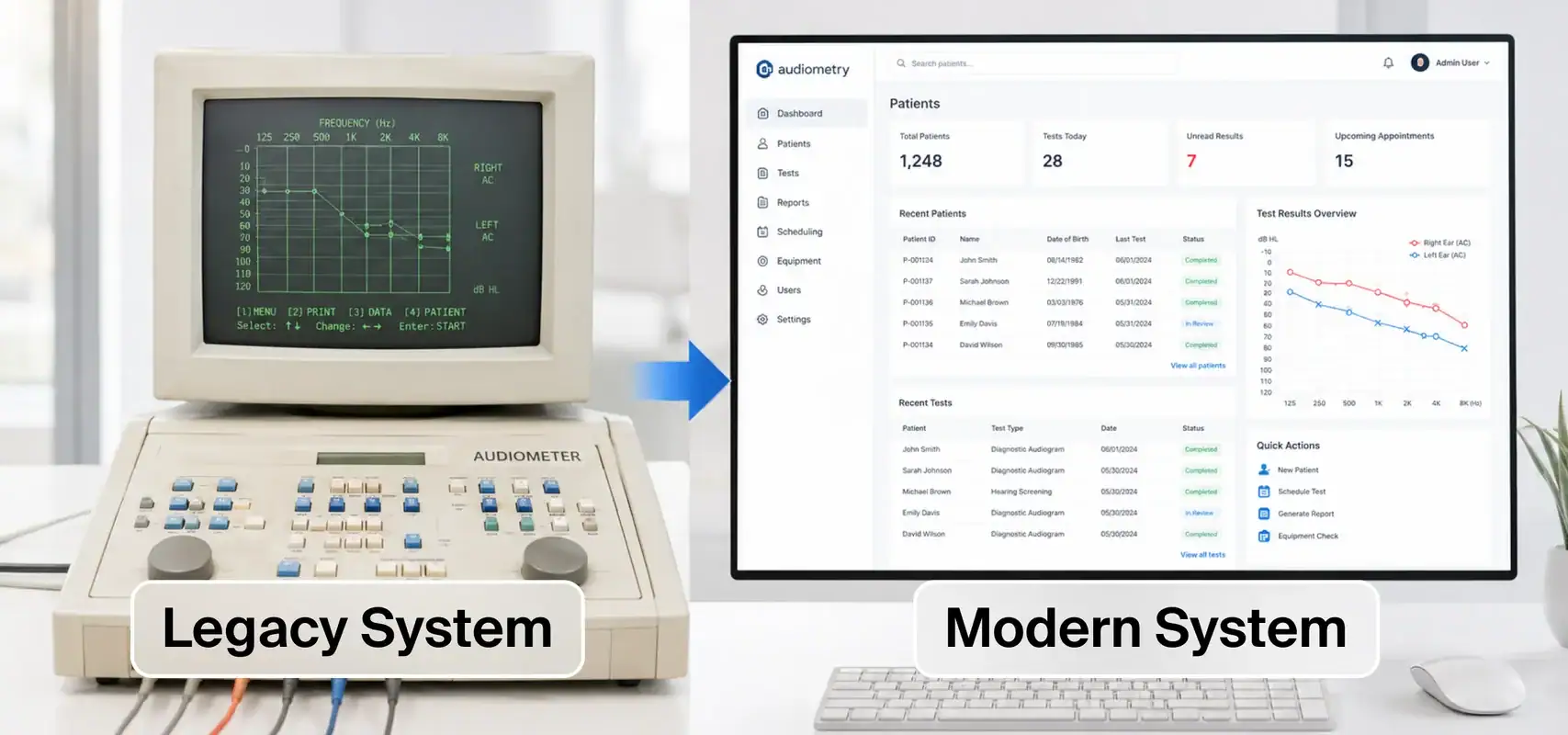
The client needed to replace a legacy audiometry system that had remained unchanged for 20 years.
They sought a modern desktop and backend solution to:
- Break free from vendor lock-in
- Centralize reporting across a network of stationary clinics and mobile units
- Generate the specific report types the legacy system could not produce.
Background
The client is a leading provider of comprehensive safety solutions, serving over 1,500 individuals daily across a network of eight locations. As part of a larger parent network, they required a robust platform capable of supporting diverse, high-scale workflows. Their operations range from high-volume stationary clinics processing up to 150 audiograms daily at peak times to smaller sites and mobile Onsite Trailer units handling roughly 5 tests a day.
The rebuild carried a financial rationale alongside the operational one: the team reports that the cost of continuing to maintain and license the legacy system was roughly equivalent to the full annual cost of building the new platform, making the project financially as well as operationally justified.
Challenges
The project identified five main challenges.
Total Vendor Dependency
The 20-to-30-year-old audiometer hardware and software were inextricably linked, leaving the client with no path to modify or extend the system independently.
Legacy Hardware Constraint
The hardware remained the same old unit with no replacements, but the software underneath had to be rebuilt from scratch to speak modern language and meet new demands.
Data Silos
The legacy system was local-only; reports could not be pushed to a central CRM, resulting in fragmented patient data across locations with no cross-site visibility.
The “Black Box” Protocol
The device vendor provided no usable technical documentation, requiring reverse engineering of device behavior to enable integration and future scalability.
Regulatory Requirements
The modernization effort introduced support for HIPAA-oriented controls and automated calculation workflows required for hearing-testing operations, including Standard Threshold Shift (STS) logic.
Process
The project began with a structured discovery phase that translated the client’s operational constraints (technicians working alone, multi-day offline mobile deployments, and strict OSHA obligations) into precise architectural decisions before any development began.
Architecture Design
The hardware remained unchanged to avoid physical disruptions to the testing stations.
Using an offline-first architecture, the team built a new desktop application that utilizes local SQLite caching and central PostgreSQL synchronization.
Authentication followed the logic: JWT tokens valid for 24 hours are cached securely via Windows DPAPI, ensuring sessions remain stable through network interruptions without requiring re-authentication during active testing.
This design ensures that technicians in mobile trailers can operate for days without connectivity, syncing data automatically once a connection is re-established.
Requirements Management
Functional requirements were structured as individually numbered specifications, each carrying explicit role-based access definitions and discrete validation rules.
Where scope evolved during the engagement, deprecated requirements were retained with visible labels rather than removed, maintaining a traceable record of decisions.
This approach provided both the development team and the client with a single, unambiguous reference point throughout delivery.
Conflict & Edge Case Resolution
Critical synchronization edge cases (such as data conflicts arising when a record updated online collides with an offline session upload for the same patient) were identified and resolved at the specification stage.
The system was designed to detect conflicts and surface them to the user for manual resolution rather than auto-merging, strictly preserving clinical data integrity.
Legacy Migration
Migration of existing legacy data was scoped as a core deliverable, not a post-launch task, to ensure operational continuity from the first day on the new platform.
Business Impact
The system is designed to serve 8 locations. The team reverse-engineered the legacy device protocol to replace vendor constraints with a modern ecosystem, which delivered the following results:
- Reduced Vendor Lock-In: While retaining existing device infrastructure, transitioned from a legacy model to full proprietary ownership of the software stack.
- Modernized UX: Replaced legacy interfaces with a role-based experience designed to simplify workflows for technicians and managers.
- Data Continuity: Established a unified data flow between testing devices and central records (CRM).

Business Impact
- Enhanced Reporting Capability: Delivered the report types the client had been missing.
- Regulatory Support: Introduced HIPAA-supporting controls and implemented automated hearing-related calculations (including STS and age adjustments), with broader regulatory validation continuing as the platform evolves.
- Offline Resilience: Enabling multi-day offline operation for mobile units with automatic conflict resolution upon sync.
- Financial Efficiency: The cost of developing the new platform is comparable to a single year of maintaining and licensing the legacy system, expected long-term cost efficiency and freeing budget for innovation.
Client’s Role & Feedback
The client provided critical domain expertise regarding their multi-location workflows and the specific permissions required for different user roles.
Operational Validation
They have actively validated the architectural direction, confirming that the new system significantly simplifies operations for both technicians and managers compared to the overloaded legacy interface.
Strategic Outlook
With the platform in active development and fully owned by the client, the parent organization has initiated plans to scale the solution, standardizing operations by migrating an affiliate in a neighboring state to the new system upon completion.
Empeek’s Team Reduces Time to Market by 15%. Start Your Project Today.
Schedule a CallOur Custom Healthcare Software Development Services
FAQs
What happens if a technician loses the internet mid-shift?
Authentication is cached locally via DPAPI for 24 hours, allowing testing to continue uninterrupted. OTP re-verification is bypassed during a tracked 7-day offline grace period.
Can two staff edit the same patient record from different locations?
The system flags the conflict and requires manual confirmation to ensure data integrity, rather than overwriting data automatically.
Does a single technician need IT support to run a location alone?
No. Each site is designed to operate with one technician on one computer; the system is designed specifically for this “solo-operator” model.
How long can a trailer location run before syncing back?
The system supports multiple days of offline operation. Data synchronization triggers automatically once connectivity returns, or can be initiated manually at any time.
 (No Ratings Yet)
 Loading...