About the Project & Challenges
Complex neurological conditions don’t announce themselves through a single channel. A post-impact patient presents with headaches and dizziness, the symptoms that are non-specific by definition.
The clinical pathway typically unfolds across separate specialist referrals: an ophthalmologist for vision, an audiologist for hearing, a vestibular therapist for balance. Each returns a separate report. A neurologist then synthesizes these in their head, manually, without a shared data model.
This is not a workflow inconvenience. It is an architectural failure.
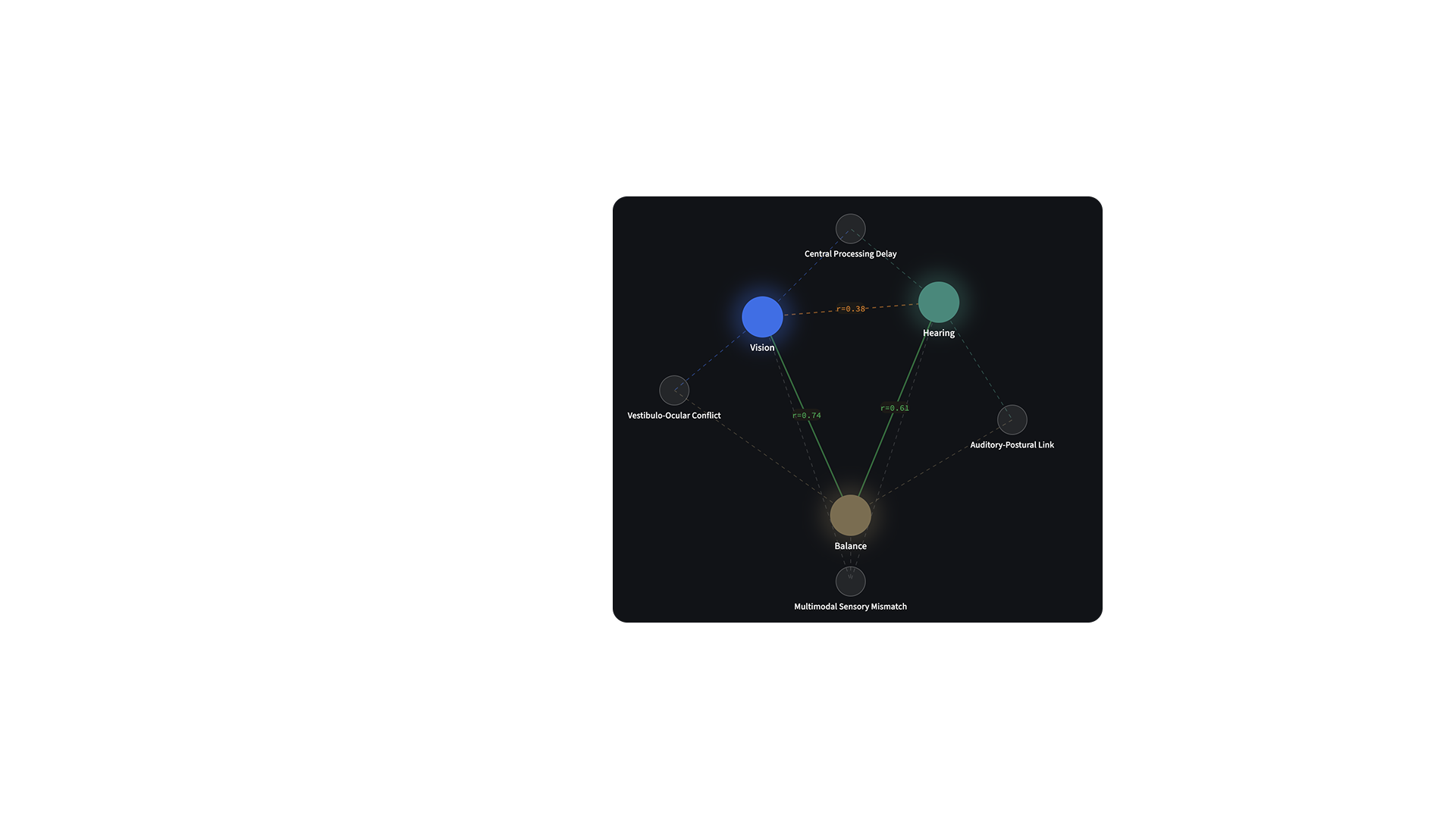
The three sensory systems (vision, hearing, and balance) are neurologically interconnected. A right-sided vestibulo-cochlear event will express itself across all three simultaneously. But when each assessment is conducted in isolation, the cross-modal pattern is statistically invisible.
Clinicians see three borderline findings. They miss one coherent event.
What we Achieved
Data Model
Shared normalized patient model.
Analysis
Automated cross-modal correlation.
Output
Structured Neuro-Score and report system.
Time to Decision
Single session, under 25 minutes.
Pattern Detection
Statistical inter-modal correlation.
Meets Regulatory Standards
Compliant with HIPAA and GDPR.
The Engineering Mandate
We designed a platform that could replace a three-specialist referral chain with a single clinical session, without sacrificing diagnostic rigor.
The system needed to ingest physiological data from heterogeneous hardware sources, normalize it into a shared model, compute cross-modal correlations in real time, and produce a structured clinical output that a neurologist could act on immediately.
The mandate was not to build a better dashboard. It was to design an integrated system in which data, analysis, and clinical output are part of one continuous pipeline, not three loosely connected tools.

Clinical Scope
The same system architecture supports seven distinct clinical workflows without modification to the underlying pipeline:
Acute concussion assessment and return-to-play decision support
Post-concussion monitoring and quantified recovery tracking
Cognitive fatigue detection in high-performance athletes
Neurological fitness screening in occupational health and compliance contexts
Longitudinal monitoring for age-related neurological decline and early Parkinsonism
Pediatric developmental assessment and differential diagnosis support
Pre- and post-surgical neurological baseline with Neuro-Score delta measurement
Core System Components
The Design Principle
The Cogni project is a concrete illustration of a specific engineering position: Systems that generate data without structuring how that data becomes a decision are incomplete products, not finished ones.
Most diagnostic platforms stop at data capture. Some add visualization. Cogni was designed to go much further, from signal acquisition to a structured output that reduces the burden on the clinician.
This comprehensive design is an architectural requirement
And it is the reason the platform can replace a three-specialist referral chain with a 25-minute session without any reduction in diagnostic depth.
If your team is building or evaluating a diagnostic platform with similar architectural requirements, we are available for a technical walkthrough of how we approached our system design.
Schedule Demo
Explore Our Core Healthcare Software Development Services
Project Discovery Phase
The aim of the Project Discovery is to understand project goals, risks, and stakeholders’ requirements before moving forward into further planning and development of the software product. This process sets the stage for the entire project by outlining objectives, opportunities, challenges, and details needed to guide the development team as well as business owners.
Learn MoreWeb App Development
We build interactive web applications that live on remote servers and can be accessed by users from anywhere. We use languages like HTML, CSS and JavaScript on the front-end and databases, servers and frameworks on the back-end to build functional, secure and scalable web apps with rich user experiences.
Learn MoreQA & Testing
We design test cases, scripts and plans to evaluate the functional, security, reliability and performance aspects of a software application. The goal is to identify defects, gaps or issues earlier on rather than post-deployment so we can address and resolve them during the development phases.
Learn MoremHealth App Development
We create applications for smartphones, tablets or wearable devices that can monitor, collect, analyze and give feedback to users about various health, wellness and medical data from sensors, user input and other connected sources. Empower your patients and improve health outcomes through greater engagement and access to information.
Learn MoreAbout Empeek
Engineering a better healthcare future.
Empeek is a custom healthcare software development company that helps healthtech startups and medical facilities create and leverage innovative, HIPAA/HITECH compliant technology solutions such as EMR and telemedicine systems, patient-centered crossplatform apps, AI-powered tools, IoT ecosystems, and others.
250+ Specialists
10+ Years on the Market
HIPAA & GDPR Compliant
 (No Ratings Yet)
 Loading...
![Revive Telehealth: Scalable Platform for Behavioral Health [Case Study]](https://empeek.com/wp-content/uploads/2024/09/revive.jpg)
![Real-Time Health Monitoring System Using IoT [Case Study]](https://empeek.com/wp-content/uploads/2024/09/biobeat.jpg)
![Healthcare Integration: Upvio and Elation EHR [Case Study]](https://empeek.com/wp-content/uploads/2024/09/upvio-integration-e1725988831453.jpg)
